Debt collection, debt enforcement and bankruptcy: the Swiss process in one overview
What happens between an unpaid invoice and formal enforcement? This post explains the key terms (payment order, objection, seizure, realisation, bankruptcy) and why process clarity reduces friction.
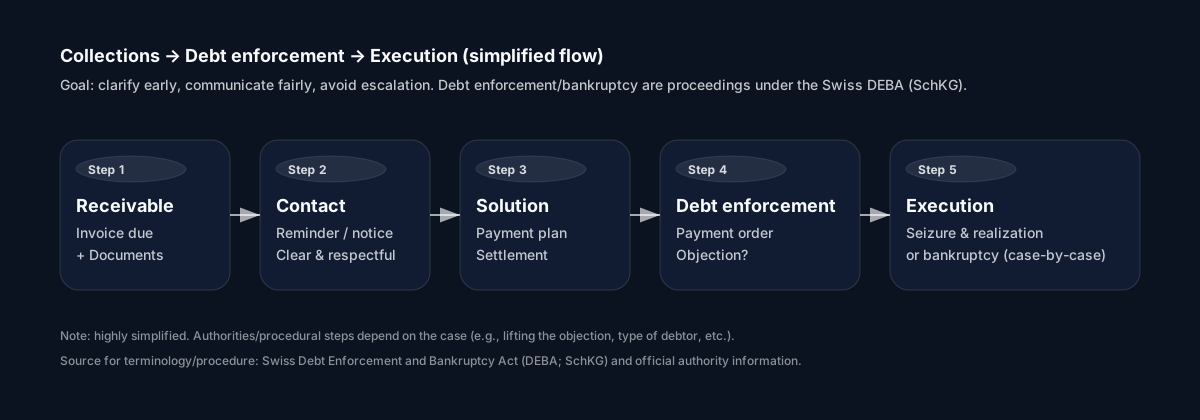
This note provides a compact process overview: how do debt collection (often referred to as Inkasso in Switzerland), formal debt enforcement, execution steps, and bankruptcy relate? The goal is clarity — because a lack of process understanding often creates unnecessary escalation (on both sides).
diagram inkasso betreibung flow
1) Terms: debt collection vs. debt enforcement vs. bankruptcy#
In everyday language, these terms are often mixed up. Keeping them separate helps:
Receivables / claims management: what a business does internally to prevent or reduce overdue receivables (invoice quality, reminders, process discipline).
Debt collection (out-of-court): structured communication (in-house or via a service provider) to clarify facts, assess ability to pay, and agree a payment plan or settlement.
Debt enforcement (“Betreibung”): the formal procedure under Swiss debt enforcement law (SchKG), typically starting with a payment order (“Zahlungsbefehl”). [SchKG]
Objection (“Rechtsvorschlag”): an objection to the payment order, which triggers additional steps (highly case-specific).
Execution steps (simplified): if enforcement continues — e.g., seizure of assets (“Pfändung”) and their realisation/sale (“Verwertung”). [SchKG]
Bankruptcy: insolvency proceedings (simplified), relevant depending on the debtor type and the specific case constellation. [SchKG]
2) Why out-of-court collection is often the main lever in practice#
In many cases, outcomes are decided before formal enforcement:
Clarify errors early: service defects, duplicate invoices, wrong addresses, unclear deliverables — the earlier corrected, the less friction.
Handle liquidity constraints: open communication and realistic instalment plans often avoid formal steps.
Protect reputation: respectful communication reduces complaints and preserves relationships where appropriate.
This does not mean formal enforcement is “bad” — it is a legitimate mechanism. But it is typically more expensive and more conflict-intensive than an early, clear resolution.
3) A taboo does not resolve overdue receivables — clarity does#
Treating debt collection as a taboo discourages robust processes (documentation, tone, escalation logic) and can discourage early contact from debtors.
A useful reframing:
Debt collection is not “punishment” — it is clarification and structure.
Debt enforcement and bankruptcy are not “moral verdicts” — they are formal procedures.
If you separate debt collection, debt enforcement and bankruptcy conceptually, you can act earlier, fairer and more efficiently: clarify first, escalate formally only if needed — with clean documentation and respectful communication. [SchKG]
This publication is provided for information purposes only and does not constitute legal, tax or investment advice. It is not an offer, solicitation or recommendation. It is directed solely at qualified investors in Switzerland and is not intended for U.S. persons.
Insights updates.
Receive selected analysis on Swiss litigation finance and regulatory developments.
Processed in accordance with our Privacy Policy. You may unsubscribe at any time.
This material is for information purposes only and does not constitute investment advice, an offer, or solicitation. It is directed exclusively at qualified investors and is not intended for US persons.